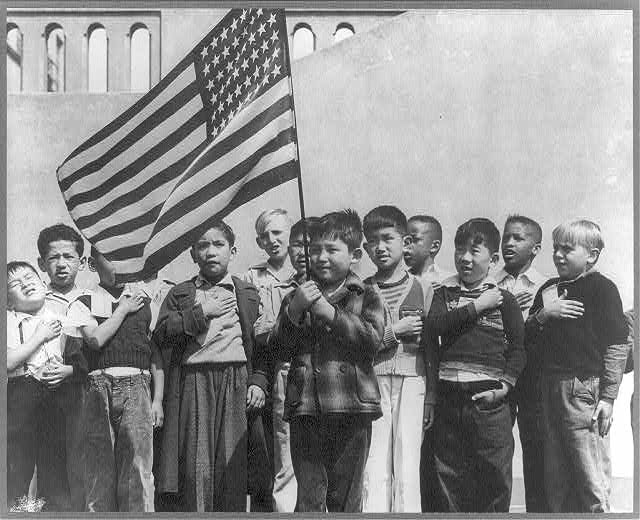

In Part 1, I shared a video of my granddaughter, Penelope, reciting the Pledge of Allegiance. While listening, I was inspired to consider each phrase and what it means to me.
Part 1 – The Pledge of Allegiance: History
Part 2 – The Pledge of Allegiance: “I Pledge Allegiance”
Here’s Penelope’s video again:
The focus of my final post on the Pledge of Allegiance is on the phrase “with liberty and justice for all.” It’s the phrase that brought a lump to my throat as I listened to Penelope. I thought of all the times I’d recited the pledge, not seriously considering the words. I questioned how many of us no longer give the words a thought. How many times in our nation’s history have we disregarded the words, “with liberty and justice for all.”
I even wondered if one day my own grandchildren might be in a category of people for whom this promise will not be upheld. After all, it was not upheld for their great grandmother — my mom. Isn’t it true, that if “liberty and justice for all” is not upheld for one group, no group is safe?
As we approach our nation’s 250th birthday, it’s easy to be caught up in patriotism, to want to disregard the times in our history when we did not live up to our ideals. There are many of those times . . . and it continues today.
So, what do these words mean? Here’s a summary per legalclarity.org:
Liberty = freedom from unreasonable government restraint — including freedoms of speech, religion, assembly, press, and personal autonomy. These protections come from the Bill of Rights and are applied to the states through the Fourteenth Amendment.
Justice = fair treatment under the law, due process, and equal protection. This includes impartial courts, nondiscrimination, and access to legal remedies.
For all = these rights apply to every person, regardless of status, identity, or background. It is an aspirational and legal commitment to universal equality.
Of course, for me, the first instance that comes to mind of a failure to uphold “liberty and justice for all” is the internment of 120,000 Japanese, 2/3 of whom were American citizens. Yet, no Japanese American was ever convicted of espionage or spying during or after World War II.
A simple search for a “list of events over the last 100 years where ‘liberty and justice for all’ was not upheld” provides multiple events. Below, I’ve listed a few that affected my family, as well as events that occur in my historical fiction novels, The Red Kimono, and its upcoming sequel, Shadow of the White Chrysanthemum (Spring 2027, University of Arkansas Press):
- Immigration Exclusion and Targeting (1924–present) – From the Asian Exclusion Act to post‑9/11 surveillance, immigrants have repeatedly been treated as suspect. Due to provisions in the Naturalization Act of 1790, Issei, or the first generation of Japanese to immigrate to the United States – my grandparents – were not allowed become American citizens until 1952.
- Japanese American Incarceration (1942–1945) – 120,000 people of Japanese ancestry — two‑thirds U.S. citizens — were forcibly removed from their homes and imprisoned without charges or trials. No Japanese American was ever convicted of espionage, yet the government justified mass incarceration on “military necessity.” Densho.org
- School Segregation (1954–1970s) – Even after Brown v. Board, many districts refused to integrate.
- Segregation and Jim Crow Laws (through the 1960s) – Black Americans were denied equal access to schools, transportation, hospitals, and public spaces.
- Anti‑Miscegenation Laws (until 1967) – Interracial marriage was illegal in many states until Loving v. Virginia. My parents’ marriage was considered illegal in many states when they were first married.
I do not present this list to dishonor the United States of America, especially as we approach her 250th birthday. I see it as “tough love,” just as it would be “tough love” for me to have a difficult conversation with my husband, children or grandchildren.
To fully love our country, we must accept it as it is, with its flaws as well as its beauty. In my own life, I’ve learned my greatest lessons through mistakes I’ve made. I believe it can be the same with our country. But first, we must remember the mistakes of our past, and recognize the mistakes of today.