Funny how working on a memoir can trigger memories. It’s as if writing about my life events fertilizes the soil of my soul, opening my mind and heart to stimuli that brings new memories to bloom.
With the first notes of the melody, I was whisked back to a time when I was maybe twelve years old. Back to Fairfield, California. Back to my living room with the green shag carpet and the gold tweed sectional where I sat and listened to my mom practice that very song in preparation for a performance with the community theater, The Belfry Players.
I was in awe of my mother’s voice. Though at twelve, I’m not so sure I knew the meaning of the word, “sultry,” as I think about her voice now, I would describe it as sultry, yet sweet and full of longing. And there was no better song for her to spotlight the characteristics of her voice that “Bésame Mucho.”
So, I asked her what the lyrics meant. What I most remember was the translation of the title: Kiss Me Much.
Oh, yes. Longing. In the words of the song, the way my mother’s voice surrounded me, I knew my she felt the longing, and I felt it, too.
She must have missed my father, who spent so much time away on his Air Force trips. Seeing my mother’s longing throughout much of my childhood, I sometimes wonder if it planted a seed of longing in me, too — a perennial flower that blossomed, died and blossomed again, many times throughout my life.
Through much of my childhood, we all missed my dad when he was away. We longed for his return, when everything at last, would be right with my mom and right with our world.
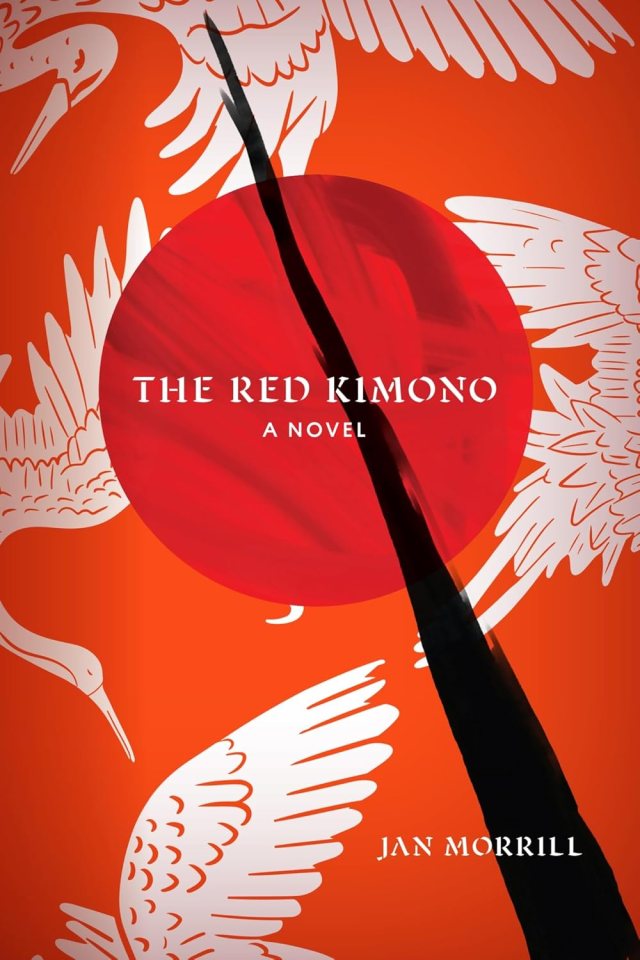
Now that I’ve finished the sequel to The Red Kimono after a LONG time (12 years!) I’m moving on to the next thing I’ve been thinking about for a LONG time — a newsletter.
Here’s a teaser from the first page.
In each quarterly edition, I’ll include updates, links I’ve enjoyed, excerpts from upcoming books, upcoming events, and other tidbits. I’ll keep those a secret for subscribers!
And, if I get some really big news, you’ll be the first to know, because I’m not above sending out a BREAKING NEWS alert!
If you’d like to subscribe, click on the “Subscribe to Newsletter” button in the upper right corner.
Almost exactly a year ago, I wrote another post about my awkwardness in a gym fitness class I attend at University Hospital Fitness Center: Flight of the Flamingo – Or Not.
In yesterday’s class, I once again laughed at myself as my gaze bounced between watching the instructor’s every move and watching my reflection in the mirror, disappointed time-after-time that my moves looked nowhere near the adorable instructor’s.
So, am I enlightened, or unhinged?
I mean, Kelly-the-Instructor was everything my physical self has wanted to be since I was fourteen-years-old. Petite, lean, limber, perky, bouncy, adorable. And her dance moves! Oh, she tried to help out my fellow classmates and me by using descriptions like, “tornado,” or “shark,” or “punch,” or “shimmy.”
But when someone yelled, “Shake your ta-tas,” (can’t remember if it was a song lyric or if she shouted it,” all I could think was, “nah-nah, not me.” (Though embarrassingly, I’ll admit, I did try—but just once.)
At one point, I was reminded of the documentary “America’s Sweethearts,” about the young women who give everything in their attempts to be a Dallas Cowboys Cheerleader. Oh, not that I was ANYWHERE CLOSE to thinking I could have ever done that, but I realized just how hard it is to do what they make look so easy. Not only did Kelly-the-Instructor make it look easy, she was having FUN as she danced in front of us. (Or she was faking it really well.) No matter how hard I faked it, I don’t think I looked like I was having fun. But actually, I was—laughing at myself! (BTW, I highly recommend America’s Sweethearts on Netflix!)
But what the heck. Afterwards I told Kelly-the Instructor I enjoyed her class, even though I felt awkward through 95% of it. At least I was moving – like a grandmotherly cheerleader wanna-be!
I like how my friend, Linda Austin distinguishes between sympathy and empathy in her post, Sympathy vs. Empathy and the Importance of Memoir. I’ve often thought our empathy “muscle” is weakening because we don’t use it enough.
I also believe social media is a cancer upon empathy. How can we see through another’s eyes, feel what a person feels, with a 280-character post (X) or a snippet of information (Facebook, Instagram)? Even worse, AI makes it difficult to even know what’s true, and it’s getting worse. Even worse than that, the algorithms that determine what appears on our pages serves only to thicken the walls of our silos.
The sad thing is, most of us are not happy with the direction we’re headed, that is, to be driven further and further apart, with less and less understanding — not of the other side, but of each other.
Yet, we continue to walk a path that is pre-determined by those algorithms, blind to people who walk beside us, people who also wear blinders born by a lack of empathy.
Today, I’m sad that Charlie Kirk, a young man who was a father and a husband, was shot and killed solely because someone didn’t like what he said. I edited out the second half of that sentence because as of this writing, none of us yet know who is responsible. Yet, I’ll bet most of us have jumped to our own conclusions.
From what I see on social media, A LOT of people have been energized by our respective conclusions, again, before we even know for sure. Perhaps it’s because there has already been so much death brought by disagreement.
Over the last 24 hours, as I’ve read comments from both “sides” on social media, as I’ve thought about where such comments have led us and will continue to lead us, I’ve decided each comment I see that spews hate or uses such ugly terms as “they want to destroy this country, vermin, fascist, piece of shit, civil war, revenge” (you get the picture) is a tiny assassin. Because although we know from experience that using social media to try to influence another to “our side,” or using it simply to let off steam, or perhaps worst of all, to get clicks or likes, is a tiny assassination attempt upon the very country we accuse the other side of wanting to destroy, a country founded on freedom of speech and diversity of opinion.
Why do we do it? Does it feel so good to be right? (IMO, “right” is in the eye of the beholder. Just because you think you’re right, doesn’t mean you’re right.) Does it make someone feel better to post that it’s time for civil war? Even if someone doesn’t come out and say it, as divided as we are now, isn’t that where we could be headed?
Many people have friends and family on both “sides,” including me. Do people who say it’s time for civil war really want to see people they love caught up in such a war? Close your eyes and think about that reality. Is “winning” worth it? Is that loved one of yours who thinks differently deserving of such thought?
It’s up to each of us to stop these little “assassination attempts” – attempts to shoot down another’s opinion. Attempts to metaphorically murder “the other side” through vilification, name-calling, humiliation, gotcha moments, what-about-isms, etc.
Disagreement is inevitable and, I believe necessary. How dull and stagnant this world would be if everyone agreed. But we can disagree respectfully. There will be times when no matter what we say, another’s opinion will not be swayed. We may get angry about it, we may not understand it, but firing away on social media about it does no good except to fortify each “side” against the other, in which case, unity has once again been fired upon. A tiny assassin.
Every 9/11, I remember something that caused me much sorrow, but also awe about who we are as human beings. Many who were dying, or thought they were dying, left final messages for loved ones. In those final moments, nothing else mattered except to express love for their spouses, their children, their friends. All that mattered was that their loved ones knew that they were loved.
I believe that in the end, love is all that matters. Some may think this is cliché. But all one has to do is remember 9/11 and the messages of those who perished. Remember farewell letters written during a time of war. Remember the words spoken at one’s death bed.
Love is all that matters. Disagreements won’t matter. Who won won’t matter. Politics for sure won’t matter. Love is all that matters.
My friend and fellow author, Kathleen Rodgers, posted an insightful review of The Magical Red Kimono on her blog last night. After receiving and reading her copy of my book, she told me she was going to post a review on her blog (as well as Instagram, Book Bub, Barnes & Noble, and Amazon!) I was grateful of course, but not surprised. Kathleen has always been supportive and motivational to me, as well as many other writers.
What did surprise me, and what made me happy as a writer, was that she “got” the book. In other words, she understood why I wrote the story, and more particularly, why I illustrated the book the way I did–with actual photographs of the internment camp as background:
Here’s a bit of insight into writers. We are often an introverted bunch, searching for the often-too-hard-to-find-and-therefore-precious time to spend locked up alone in a room with our stories and characters. (That might be a slight exaggeration, but nonetheless, it describes our desire to JUST WRITE!)
Then, once we get a book published, we must put on different hat, which demands the opposite of that inclination to be alone and write. We must GET OUT THERE (yes, I’m yelling now) and publicize (AKA brag about) our books.
It can be an uncomfortable thing to do, at least for me. I don’t like to over-publicize. I don’t like to ask for reviews. I just want people to read my stories and “get” (understand) them.
Just this morning, my husband and I were talking about this very thing–about how challenging it can be for an author to go from writing to marketing. Not only is it a conflicting personality trait, but marketing takes up so much of the time that I’d rather spend writing.
Like a child who doesn’t want to do her homework, I said, “I wish I didn’t have to spend so much time marketing.” Then, in reply to my own complaint, I said, “But what’s the use of publishing a book if I don’t try to get it read?”
And therein lies a writer’s dilemma.
Then comes along someone like Kathleen, who, with a review like the one she wrote, helps me to market — ie, get news of my book out there. I’m grateful for authors like her who support other authors, because I know that takes up her writing time. (I know, because I could do better!)
And yet, she is a prolific and persistent writer. Her FIFTH novel, The Llano County Mermaid Club, will be released by University of New Mexico Press in September 2025.
I believe she has had three novels published in the time it’s taken me to continue working on my sequel to The Red Kimono. (But I’m almost finished . . . except for the aforementioned writer’s dilemma . . . marketing The Magical Red Kimono!)
So, I’m all the more appreciative of the time Kathleen took to write her review and share it. Most of all, she “got” The Magical Red Kimono. As an author, that means the world to me.
Click HERE for a previous conversation between Kathleen and me.
The Magical Red Kimono tells the story of Sachi and Jubie, two little girls who discover that magic can happen when they embrace their differences. Inspired by characters from Jan Morrill’s historical fiction, The Red Kimono, The Magical Red Kimono features Sachi sharing her kimono with Jubie and teaching her a Japanese dance. As Sachi introduces her Japanese culture to her best friend, readers can learn along with them!
Tomorrow, April 24, is Release Day for my first children’s book, The Magical Red Kimono. An author waiting for a book release is like a child waiting for Santa to come on Christmas Eve!
How to pass the time, how to pass the time? How about I give you a little background on the book?
I first started writing it in 2013, shortly after the publication of my historical fiction, The Red Kimono. (University of Arkansas Press, 2013) The Magical Red Kimono is based on the following scene from The Red Kimono.
Jubie folded her hands in front of her. She looked down and closed her eyes. Her skin was about as far away from white porcelain as the number one was from a thousand. Still, she reminded Sachi of the geisha dolls she left in California.
Sachi began to hum “Sakura”—the cherry blossom song. Her voice quivered with nerves. At least Mrs. Franklin and Auntie Bess didn’t know what the song was supposed to sound like, and wouldn’t know if she mispronounced some of the words. She took a deep breath. “Sakura, sakura . . .”
Jubie raised her arms, exposing the kimono’s long, flowing sleeves. She tilted her head up, as if gazing at cherry blossoms on a tree. Mama’s kimono must have cast a magic spell on Jubie’s skinny, awkward frame, because she was prettier than Sachi had ever seen her.
Jubie swayed her arms back and forth, dipped and rose, then turned around.
Trying hard to make her tune match the beauty of Jubie’s dance, Sachi continued to sing. “Yayoi no sorawa.”
Mrs. Franklin and Auntie Bess watched from the sofa. Their eyes glistened with tears.
Jubie turned slowly, holding one arm up, and sweeping the other behind her. She looked at Sachi with a twinkle in her eyes. When the song ended, she returned to her starting position and again, closed her eyes.
For a moment, the room was silent. Then, Auntie Bess cheered and clapped her hands.
Mrs. Franklin wiped a tear from her cheek. “Oh, baby. That was so pretty. So pretty.”
Sachi clapped too. “You looked just like a geisha.” She covered her mouth with her hand and giggled. “Well, almost.”
Jubie ran her hands over the long, silk sleeves. “It musta been your mama’s kimono. Dancing just felt right today, like magic.”
Why did it take me so long to finish the book? The art work. I love art, but I wouldn’t consider myself an artist. Halfway through the book, I had a difficult time deciding how to create the remaining artwork.
Then, early this year, I found an artist I liked. When I asked about his availability, I learned he wouldn’t be available until June. I thought, “Well, heck! I can finish the artwork before June!” I guess that was the kick in the pants I needed to get off my “you-know-what!”
I was thrilled when Solander Press accepted The Magical Red Kimono for publication. Visit the website for an excellent selection of books!
Many of you who have read The Red Kimono know that Sachi is based on my mother, who was an internee during World War II. What you may not know is how Jubie came to be, and it’s one of my favorite stories of the writing of the book.
Jubie was born out of necessity. Over the 3-4 years I was writing The Red Kimono, I was a member of a fantastic critique group in Fayetteville, Arkansas. Without the members (many who remain dear friends), I would never have completed The Red Kimono, and therefore, neither The Magical Red Kimono.
One night during critique, my friend, Patty, after months and months of weekly readings of The Red Kimono’s draft she said, “Oh my gosh, is there ever anything happy going to happen in this book?” (Only the best of friends can be so honest with each other!) So, the dilemma was, how does one add happiness to a story of a family’s internment?
Enter Jubie Lee Franklin, a little Black girl who lived in the town in Arkansas where Rohwer Internment Camp was located. Sachi and Jubie meet and become instant friends. They are different in many ways, but it is their similarities that bring them together.
Jubie is a compilation of the sisters of the White family, who lived across the street from us while growing up in Fairfield, California. Two of the sisters were good friends of two of my sisters, and they would often come over. Being rather shy and reserved as a child, I loved their openness and freedom to “be.” I still remember envying those characteristics and created Jubie in their memory.
To this day, she remains my favorite character to write.
In The Magical Red Kimono, you’ll discover the friendship of two very different girls, and you’ll learn what magic can happen when they discover each other’s differences.